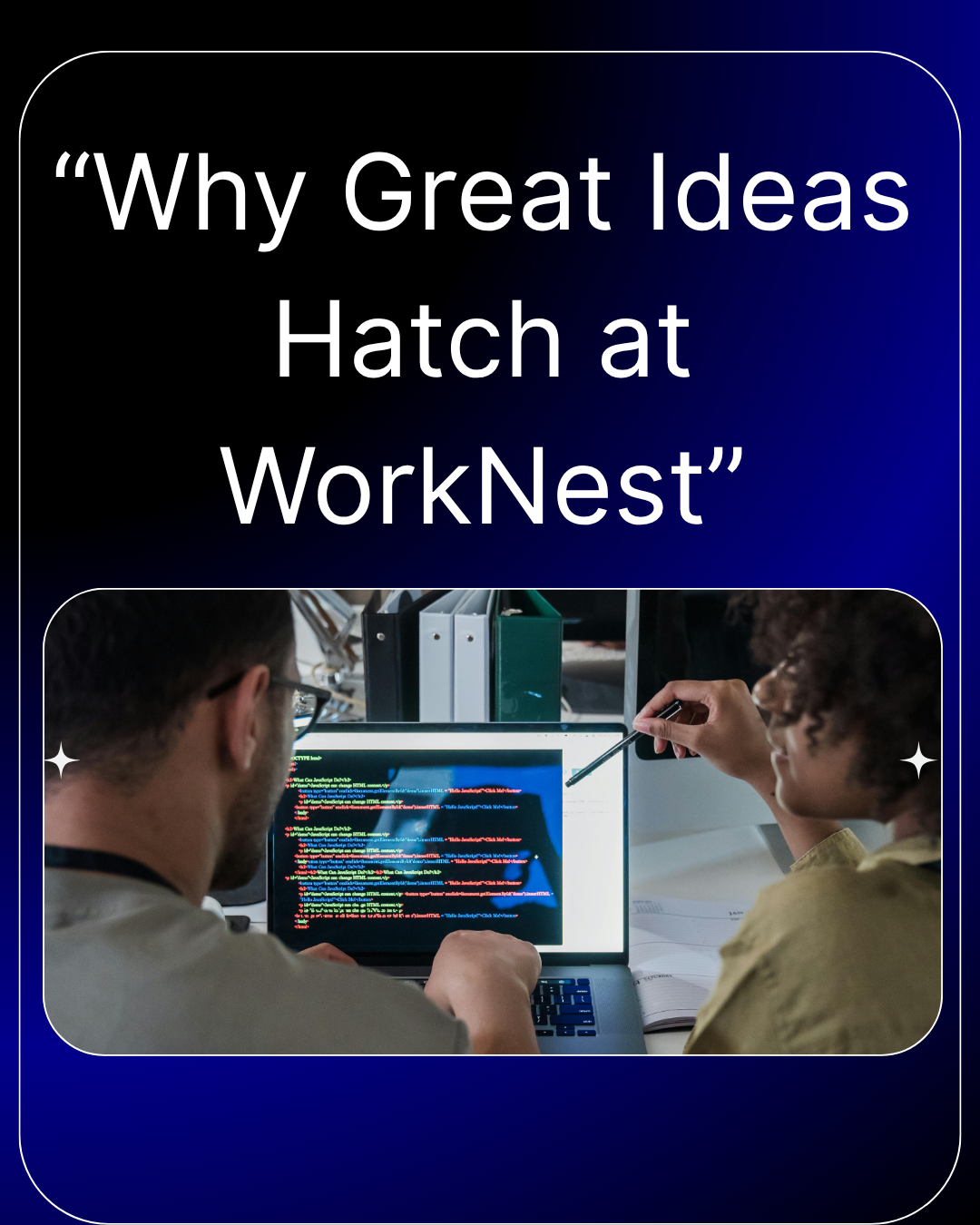
Why Great Ideas Grow at WorkNest.
Introduction: The Birthplace of Breakthroughs.
Each good idea has a birth place a point, a place and a flame where it dies into being. It is true that whether it be the seed of a start up, the keystone of a new product or a creative campaign that takes an industry by storm, it is the environment that assists an idea in its inception which usually spells its future. WorkNest was developed on that fact the belief that ideas are delicate but mighty, and when given the correct ecosystem, they can evolve into unbelievable realities.
WorkNest is not any other co-working space or office solution, but a living breathing ecosystem of innovation. It is the intersection of thinkers, makers and doers. It is where structure is combined with creativity and where teamwork produces results. And what is so special about WorkNest? Why are great ideas hatched here more than at any other place?
This post examines the underlying causes – the psychology of the workspace and the philosophy behind the design, the culture of the community and rituals that drive invention. We shall unravel what is making WorkNest the nest of innovation.
Chapter 1: The Science Behind the Nest Effect.
WorkNest is not just the name, picked without reason. The idea of a nest refers to security, development and flight preparation. A nest is a place of creation in nature, it is a safe place to develop potential to a point when it is ready to fly. The same rule is applied to the creative and professional ecosystems.
Environmental psychological research indicates that the workspace design can radically affect the creativity, concentration, and emotional state. The way our brains process ideas is influenced by colors, lighting, layout as well as ambient sound levels. This is designed in every inch in WorkNest. The intention of calmness and energy comes out of the moment you enter the inside.
Subdued lighting stimulates free“Why Great Ideas Hatch at WorkNest” thinking. The mind is encouraged to open up through natural textures, open spaces, and greenery. Deep work can only be done in quiet zones, whereas communal lounges can be used to engage in spontaneous conversations, or those accidental moments that are likely to give life to the best ideas. Establishing the optimal compromise between loneliness and sociality is the so-called Nest Effect that many regulars refer to.
Chapter 2: Built on Creativity, Designed on Purpose.
The architecture of WorkNest is the convergence of the form and functionality. Desks, walls and corners each have a tale to tell. A group of architects and behavioral scientists studied creative professionals and their movements, thought, and how they work together, and designed the space accordingly.
Natural Light as Fuel:
The open floor plan at WorkNest will guarantee maximum sunlight. Studies have always indicated that natural light is better in elevating mood and augmenting cognitive performance. Individuals in light, daytime offices claim to experience increased energy levels and more stable and continuous levels of creativity.
Areas of Inspiration:
There are psychological reasons behind every area of WorkNest. Deep concentration Focus Pods. Brainstorm Corners: Ideation of the team. The unstructured interaction Lounge. This zoning makes sure that members are able to alternate easily among thinking mode reflective, collaborative and productive.
Sensory Harmony: Minimal scents, such as citrus and cedar, make one feel alert and relaxed, whereas the acoustic design reduces unpleasant noise but permits a pleasant sound of life. The surrounding is not oppressive.
It is not just an aesthetical design, but also strategic. It makes creativity not imposed but induced, cultivated and set free.
Chapter 3: The Community Chemistry of Power.
The core of WorkNest is the most significant element the people. The members are known as the Nestlings, and they represent many differences of life: tech entrepreneurs, designers, writers, consultants, social innovators. Their only similarity is that they love to create, they want to make something significant.
WorkNest is based on open culture, as opposed to traditional offices where departments are isolated and hierarchy is a dominant factor. The entrepreneur will have a coffee with a graphic designer, or the sustainability consultant will have a chat with an AI researcher. These hits of ideas are not accidental ones, they are included in the DNA of the WorkNest.
Competition Over Collaboration.
There is competition, of course, but it is cordial or rather the type of competition where one tries to perform better and not one trying to outdo the other. WorkNest also holds monthly, informal events (called Idea Exchange) where the members can present what they are working on and can receive feedback. The response is not criticism, it is collaboration in a disguise. The result of this free flow of ideas is usually unforeseen alliances.
Teamwork, Unequal ability.
The talent pool is diverse, and therefore, it is in a position to get a solution within a shorter period of time. Need branding for your app? On the other side of the table there is a creative. In need of an investor relationship? The next booth founder has somebody he knows. The community is a living neural network that disseminates knowledge and opportunities in a way that a structured system would not be able to.
At WorkNest, individuals do not network but simply co-create. And those co-creations are the secret sauce to innovation.
Chapter 4: Rituals That Bring Innovation.
Good ideas do not airdrop, but they require rites to stimulate them. WorkNest realizes that both creativity is spontaneous and developed. Cultures have developed over the years; it is a collection of cultural rituals that maintain the energy live.
The Morning Momentum
Every morning, WorkNest welcomes its visitors with low ambient music, fragrance of freshly cooked coffee, and calm energy buzz. Most of the members are guided by a personal ritual – minutes of journaling, a meditation or a quick chat in the kitchen. Such little things create a psychological preparedness of the day.
The Midday Mix
WorkNest Lunchtime is a sacred connection time. The cafe turns into a pot of discussions. Individuals exchange stories, ideas and burdens. Numerous innovations have occurred not within meeting rooms, but at common tables.
The Idea Hour
WorkNest has an Idea Hour every week, which is a brainstorming session by the community. Early-stage ideas or issues are brought by members and everybody gives ideas. It is a rule, and it is easy, suspend judgment, increase possibilities. It is a place of crazy thought, where no idea can be too wild to think of.
The Friday Reflection
WorkNest Fridays end with The Reflection Circle members will meet and celebrate wins, share what was learned and thankful. It is a bit of a debrief, a bit of a community bonding and it strengthens a feeling of mutual development.
Not events, these rituals are triggers that make creativity flow not like a break, but like a stream.
Chapter 5: Psychology of Safe Spaces.
In order to create, individuals need to have a sense of security, both psychologically, emotionally, and socially. Psychological safety is among the founding principles of WorkNest: the idea that no one should be afraid of being judged or ridiculed because of his or her thoughts and experiments.
Such openness is preserved as a deliberate culture. The new members are not only introduced to the facilities but also to the values: respect, curiosity, and kindness. Every voice is known to count.
This safety net helps people to be creative risk-takers. When one gets support, he or she is not afraid to present outside-the-box ideas since failure in this case is not fatal but rather enlightening. Such an attitude change converts teams that are average performers to power houses in innovation.
Chapter 6: Learning as a Life Line.
WorkNest is not an inert place, it is an active campus of perpetual education. Workshops on design thinking, digital marketing, mindfulness, and finance to startups among others are hosted by experts every month. The members do not learn because they are forced to, but because the environment makes them curious.
These educational workshops are not knowledge transfers but community development. As individuals study as a community, they develop as a community. The mutual development promotes joint force.
It has an internal library too where books on creativity, leadership and innovation are found. It is a refuge to many members to revitalize the mind.
Chapter 7: The place of Nature and Space.
Enter WorkNest and you will be able to tell that it is breathing. It has plants along the walks, the walls are natural wood and the sunlight is coming through the oversized windows. The design is designed with biophilic nature on purpose – to help humans connect to nature to enhance their mental clarity and emotional equilibrium.
This is supported by science: the presence of greenery and natural materials changes the level of stress and improves the creative performance. According to members, they tend to feel more relaxed, more alive and more creative. It is not only decor, but neuroscience in design.
The open terraces, e.g., are not only to take breaks but to brainwash. A lot of teams relocate their brainstorming activities to the open air to have their minds cleared. The result? Concepts that are lively as the surrounding is.
Chapter 8: The Collaborative Power of Technology.
Technology is the unseen force of WorkNest, although it runs on human energy. Remote working is hassle-free with high-speed connectivity, meeting systems and built-in collaboration tools. The users are able to freely transit between physical and cyberspace.
The NestNet in-house platform, which is simply known as NestNet, enables members to interact, give updates, seek assistance, or provide knowledge. It is a sort of an in-house system of social networks created with the only purpose to be creative and supportive. It is also equipped with a digital Idea Vault, in which individuals have the ability to post their brainstorms, receive feedback and monitoring their progress.
Technology at WorkNest does not eliminate human connection, it just makes it better. It also eliminates friction in order to allow innovation to run free.
Chapter 9: Leadership and Vision -The Steering Force.
A vision is what holds every successful ecosystem behind. WorkNest was established with a distinct mission that is to provide the most motivating place in which ideas will be incubated and nurtured. Its founders were businessmen and creatives themselves who could feel the restricting nature of a conventional office approaching creativity.
They wanted to create something new – a place that encourages individuality and lives by community. One that could be dreamers and doers.
The WorkNest leadership is non-hierarchical. The decisions are made together, feedback is promoted among all people and transparency is appreciated. This culture permeates in all aspects including the way members relate and the manner in which events are arranged.
Leaders who demonstrate the behavior of openness and curiosity will see the whole community reflect on the same. That is why WorkNest is not merely a workspace, but it breathes an air of motion.
Chapter 10: True Stories, True Impact.
Stories have been created in every single corner of WorkNest, ideas that were hatched in this place and went out to create ripples.
This was the chance meeting of a team of designers and educators who came up with a children learning application that is now in use in many schools across the country.
A sustainability consultant and an architect worked on a zero-waste building project following a meeting during an Idea Hour.
The author of one of the best sellers was a freelance writer who got her idea after spending months in one of the silent Focus Pods.
The latter are not mere coincidences; these are evidence that the environment does count. Creation would follow when you surround yourself with thinkers, doers and dreamers.
Chapter 11: The Compromise of order and liberty.
The greatest strength of WorkNest is also its duality, it is not too structured and at the same time not too free. There are resources, events and systems that lead the members in being productive, yet the members are not locked down.
Clock-ins and dress code do not exist. Individuals are free to work at their pace – some are morning workers, others evening. The key is trust. WorkNest has the trust that its members will be responsible about their energy, time, and creativity.
Such freedom, along with the soft structure, produces a perfect psychological state of innovation – accountability and autonomy. That is why some people tend to state that WorkNest is not an office but rather a creative refuge.
Chapter 12: Wellness as an Imaginative Impetus.
It is impossible to flourish creatively in burnout. Wellness is part of the philosophy of WorkNest. Mindfulness rooms, yoga sessions, ergonomic chairs and mental health workshops are present. The simple credo goes like this: healthy mind produces healthy ideas.
A large number of members testify how these little wellness programs changed their working behavior. They also trained themselves never to work at their limit of exhaustion, but to recharge, and to find that ideas come most easily not when one is stretched, but when one is relaxed.
The cafe offers healthy food that helps to improve brain activity, and there are hydration points all over the place. The quality of air is also controlled and optimized. It is a whole system ecosystem that deals with human performance.
Chapter 13: Local Hub to Global Movement.
What started as one co-working“Why Great Ideas Hatch at WorkNest”“Why Great Ideas Hatch at WorkNest” space has become an intercity community. The work Nest offices globally have the same philosophy but are culturally adjusted. The spirit is the same, creativity, connection, and care but each Nest is unique.
The concept of digital connectivity implies that the members of various cities could work together easily. WorkNest is now more than a physical place, a notion, a philosophy that borders no geography. It fosters innovation wherever it exists, wherever it is.
Chapter 14: Measuring What Matters -The Impact of Ideas.
WorkNest does not equate success using profit and occupancy rates. It quantifies it through concepts conceived, initiatives initiated and societies transformed. At least once a quarter, members are encouraged to report their milestones not in the form of a competition, but as a mass celebration.
Nest Impact Report shows progress in all sectors, including startups, patents, employment opportunities, and social causes. These measurements are even more telling as they show that once a person is provided with the proper environment, innovation thrives on its own.
Chapter 15: The Future of WorkNest The Future of Work.
Work is evolving in the future. The virtue of flexibility, teamwork, and creativity is on the rise. WorkNest is an illustration of such a future, as people will not simply work but will be a part of a home.
New technologies, work teams, and work models will keep transforming the way we make. The mission of WorkNest is to be the soil upon which that evolution will occur, to make sure that however the work occurs, ideas will still be conceived and laid, and fly.
Over the next few years, WorkNest plans to make new investments in new cities, sustainability and enhance its learning programs. Nevertheless, it will continue to promise its essence, namely, to be the nest where creativity will be born.
It is concluded: Where Ideas Learn to Fly.
Good ideas do not just come in a vacuum. They require affection, security and churning. They require communication and silence.“Why Great Ideas Hatch at WorkNest” Failure and freedom are what they require. They need a nest.
WorkNest is such a nest – a living breathing ecosystem where creativity flourishes and innovation is created. It is not only the places of where people work, but it is the places where people grow, relate and realize visions in reality.
It takes WorkNest to be where the future itself starts taking flight, in case every great idea must have a place to hatch.